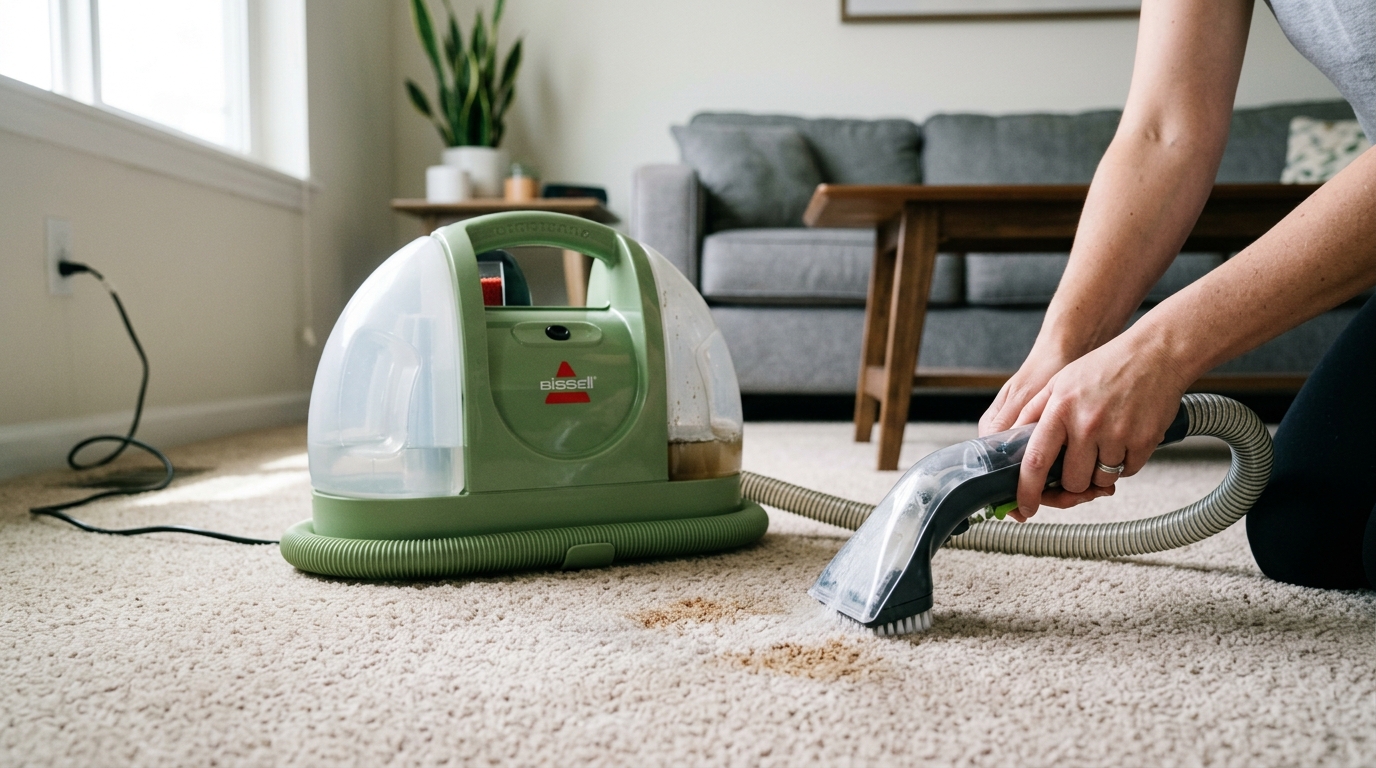
Cleaning tools have a way of revealing how people actually live. A full-size carpet washer makes sense in a home with wall-to-wall carpeting and a schedule for deep cleaning. A handheld vacuum handles the daily crumbs and dust. But between these two extremes lies a category of mess that neither tool addresses well: the spilled coffee on the area rug, the pet accident on the sofa cushion, the mud tracked into the car’s back seat. These are the moments when a portable spot cleaner proves its worth, and the BISSELL Little Green Mini Portable Carpet Cleaner, 4075, is designed specifically for them.
This guide examines the device from the ground up—what it does, how it works, where it fits, and what limitations come with its compact design. The goal is not to sell, but to inform, so that anyone considering this type of tool can make a decision grounded in practical reality rather than marketing language.
Understanding What This Device Is
The Little Green Mini is BISSELL’s compact version of its well-established Little Green portable carpet cleaner line. The fundamental cleaning method—spraying solution, agitating with a brush, and extracting the loosened dirt with suction—remains the same as its larger siblings. What changes is the scale. At approximately 7 pounds and with a footprint of roughly 13.5 by 12.1 by 10 inches, this model is built to be stored conveniently and retrieved without effort.
The design philosophy here is worth noting. This is not a device intended to be carried around like a handheld vacuum. It is a device intended to be accessible—small enough to keep in a closet or cabinet, light enough to lift without strain, and simple enough to set up in under a minute. The bet is that a cleaning tool which is easy to reach will actually be used, and that using it promptly on a fresh stain produces better results than waiting for a scheduled deep clean.
Model 4075 is a corded unit. It comes with a 12-foot power cord, a 4-foot hose, an 8-ounce trial bottle of Little Green OXY formula, a 4-inch Tough Stain Tool, and a HydroRinse self-cleaning hose tool. The color is a Tea Green finish that matches the Little Green product family.
Key Features in Detail
The Spray, Scrub, and Extract Method
The operating principle is straightforward and effective. Cleaning solution is sprayed onto the surface being treated. The bristles on the tool head then work the solution into the fibers, loosening dirt and grime that has bonded to the material. Finally, suction pulls the liquid—along with the dissolved debris—back into the dirty water tank.
The extraction step is what distinguishes this type of device from simpler cleaning methods. Wiping a surface with a damp cloth moves dirt around and leaves residue behind. A portable extractor reaches into the material and removes the contaminated liquid, which is why the results tend to be visibly different from surface cleaning alone.
Two-Tank System
The unit uses separate tanks for clean and dirty water. The clean water tank holds 16 ounces of water mixed with formula, while the dirty water tank holds 13.5 ounces of collected liquid. Keeping these separate matters for two reasons. First, it prevents dirty water from being reintroduced to the surface being cleaned, which would undermine the entire process. Second, it allows the user to see exactly how much contamination has been removed, which provides useful feedback about when to stop.
Both tanks are removable. Filling the clean tank and emptying the dirty tank are simple operations that do not require disassembling the machine.
Included Tools
The 4-inch Tough Stain Tool is the primary attachment. It combines the spray nozzle, the brush bristles, and the suction intake in a single head, and it features a clear window so the user can observe the extracted liquid. This visual feedback is genuinely useful—when the liquid running through the window starts to look clear, the stain is likely as removed as it is going to get.
The HydroRinse self-cleaning hose tool is a separate attachment used after cleaning is complete. It connects to the hose and flushes the interior with water, which helps prevent residue from accumulating and producing odors between uses. This is a small addition, but it addresses one of the common complaints about portable extractors: the tendency for hoses to develop a stale smell over time.
Compact Dimensions
The physical size of the machine is one of its defining characteristics. It fits in spaces where a full-size carpet cleaner cannot go—under a sink, on a closet shelf, in the trunk of a car. The 12-foot cord provides reasonable reach within a room, and the 4-foot hose allows the tool head to access areas that the main body cannot.
Practical Ways to Use It
Before Cleaning
Preparation makes a measurable difference in results. Loose debris should be removed with a regular vacuum first. Crumbs, pet hair, and solid particles can clog the tool head and reduce suction efficiency. For older or more stubborn stains, applying a pre-treatment and allowing it to sit for a few minutes before running the machine can help loosen the material.
Filling the Tank
The clean water tank is removed and filled with warm water—BISSELL recommends a temperature not exceeding 60°C—along with the appropriate amount of formula. The tank includes fill markings, and following them rather than estimating is the simplest way to avoid over-concentration, which can cause excessive foaming.
Priming the Pump
After the tank is reinstalled and the unit is plugged in, the power button is pressed. On first use or after the machine has been stored for a while, the spray trigger may need to be held for about 30 seconds to prime the pump before solution flows consistently. This is a normal part of the process, not a malfunction.
The Cleaning Motion
The tool head is held a few inches above the stain. The trigger is pressed to wet the area with solution, then released while the bristles gently work the surface. The tool is tilted forward so the suction nozzle makes contact with the fabric, and it is pulled slowly backward. The cycle of spray, scrub, and extract is repeated until the liquid in the window runs clearer or the stain visibly fades.
Slow, deliberate passes tend to produce better results than quick ones. The suction needs time to pull liquid from the fibers, and rushing the motion leaves moisture behind.
After Cleaning
Once the session is complete, the hose is lifted and run for a few seconds to clear remaining water, and the unit is powered off. The dirty water tank is emptied and rinsed, the hose is flushed with the HydroRinse tool, and all components are allowed to dry thoroughly before storage. This routine takes only a few minutes but significantly affects how the machine performs over time.
Who This Device May Suit
Households with Pets
Pet owners deal with a specific category of cleaning challenge: accidents that need to be addressed quickly, before they set into the fibers and become permanent. A portable extractor that can be retrieved and set up in under a minute is far more likely to be used immediately than a machine that requires planning and effort to deploy.
Families with Young Children
Spilled juice, dropped food, and the general unpredictability of young children create a steady stream of small messes. Being able to address them as they happen, rather than waiting for a scheduled cleaning day, often determines whether a stain becomes a permanent feature of the furniture.
People with Limited Storage Space
Apartments, dorm rooms, and smaller homes often cannot accommodate a full-size carpet washer. The compact dimensions of the Little Green Mini make it a more realistic option for these environments while still providing the extraction function that makes a real difference in cleaning results.
Car Interior Cleaning
The 12-foot cord and 4-foot hose allow the unit to be used in a garage or driveway, provided there is a power outlet within reach. Seats, floor mats, and upholstery can be treated with the same spray-scrub-extract process used on home fabrics. For anyone who wants to keep a car’s interior in good condition without scheduling professional detailing, this is a practical option.
Those Who Prefer to Avoid Rental or Service Calls
For occasional, localized stains, owning a small spot cleaner can be more practical than renting a machine or hiring a professional service. The trade-off is that the device is not intended for large-area cleaning, so expectations should be set accordingly.
Important Considerations
Tank Capacity and Its Real-World Implications
The 16-ounce clean tank and 13.5-ounce dirty tank mean the unit is not built for extended, uninterrupted cleaning. Cleaning an entire car interior, for example, may require multiple refills and dumps. Some users have observed that water consumption was higher than expected. Understanding the device as a spot-treatment tool rather than a room-scale cleaner helps set realistic expectations and prevents frustration.
Corded Operation
Model 4075 relies on a power outlet. The 12-foot cord covers most indoor scenarios, but cleaning a car parked far from a building may require an extension cord. In exchange, the corded design provides consistent suction for as long as the session requires, without the battery limitations that affect cordless models. This is a trade-off worth weighing against how and where the device is likely to be used.
Results on Older Stains
Feedback from users frequently points to the same pattern: the machine performs well on fresh spills and everyday grime, but older, deeply set stains may only lighten rather than disappear completely. This is not a flaw unique to this model. All portable extractors face physical limits related to solution contact time, brush agitation, and suction strength. A reasonable expectation is significant improvement rather than guaranteed restoration.
Routine Maintenance
The two-tank system and hose require cleaning after each use. The HydroRinse tool simplifies the hose flushing step, but the dirty tank and tool head still need manual rinsing and drying. For anyone seeking a completely maintenance-free tool, this requirement is worth factoring in. On the other hand, the maintenance routine is short and straightforward, and neglecting it is what causes most long-term performance issues in this type of device.
Water Temperature
BISSELL specifies a maximum water temperature of 60°C. Exceeding this can damage components. Using warm water within the recommended range improves cleaning effectiveness compared to cold water, but hotter is not better beyond the specified limit.
A General Comparison of Categories
Portable spot cleaners tend to fall into a few broad categories, and understanding the differences can help narrow down what makes sense for a given situation.
Corded portable cleaners, like the Little Green Mini 4075, draw power from an outlet. They offer consistent suction for as long as the session requires, within the limits of tank capacity. Their main constraint is the need for a nearby power source.
Cordless portable cleaners trade continuous power for freedom of movement. They are convenient in locations without easy outlet access, but typically run for 15 to 20 minutes per charge and may offer somewhat less sustained suction. Battery life and recharge time become part of the routine.
Full-size carpet cleaners provide larger tanks and wider cleaning paths, making them suitable for whole-room or whole-home carpet shampooing. They are heavier, bulkier, and less convenient for quick spot treatment.
The Little Green Mini occupies a middle position. It is lighter and more compact than a full-size machine, more powerful and longer-running than most cordless options, and more capable of deep extraction than a simple handheld vacuum. Which category fits best depends on how the user prioritizes convenience, cleaning power, and storage space.
Frequently Asked Questions
Can this device be used on hard floors?
The Little Green Mini is primarily designed for soft surfaces—carpets, area rugs, upholstery, mattresses, and car interiors. While the suction function could technically be used on tile or hardwood, the brush and nozzle design is not optimized for hard flooring, and results may be less effective than with tools designed for that purpose.
Is it necessary to use BISSELL formula?
BISSELL recommends its own formulas for best results and lists compatible options such as PET PRO OXY, Little Green OXY, and Simply Spot & Stain Pet. Using non-approved solutions can create excessive foam, which may interfere with the machine’s operation. One user reported foam escaping from a safety vent after using too much solution, requiring a pause in cleaning.
How much formula should be added to the clean tank?
The tank includes fill markings. On the 4075, the “small area” setting typically corresponds to roughly 14 ounces of water and 2 ounces of formula, while the “large area” setting uses a different ratio. Following the markings rather than estimating is the simplest way to avoid over-concentration.
What happens when the dirty tank fills up?
When the dirty water tank reaches capacity, the sound of the motor changes and suction drops noticeably. This signals that the unit should be powered off, the tank removed and emptied, and cleaning resumed afterward.
How should the hose and tool be cleaned?
After each use, the hose end is lifted and run for a few seconds to expel remaining water. The HydroRinse tool is used to flush the hose interior. The tool head’s clear window can be removed, and the bristles and suction area rinsed with warm water. All parts should dry fully before being reassembled for storage.
Does it require assembly?
The unit arrives largely assembled. Attaching the hose and tool, filling the tank, and priming the pump are the main steps before first use. The included manual covers the process.
How long does a full tank last?
The 16-ounce clean tank is intended for spot treatment, not extended cleaning. A single small stain may use only a fraction of the tank, while cleaning a larger area or multiple stains may require refilling. The dirty tank fills proportionally to the amount of liquid extracted, so both tanks tend to need attention around the same time.
Can it be used on mattresses?
Yes, the device is suitable for mattress surfaces, provided the mattress fabric is compatible with moisture. The extraction function helps remove liquid, but mattresses should still be allowed to dry thoroughly after cleaning to prevent moisture-related issues.
Is it suitable for stairs?
The 4-foot hose and 4-inch tool make it possible to clean stair treads, though the main unit needs to be positioned on a stable surface nearby. The compact size of the tool head is an advantage in this context, as it can reach into the corners and edges of each step.
Conclusion
The BISSELL Little Green Mini Portable Carpet Cleaner, 4075, is a targeted tool for a specific type of cleaning. It is not a replacement for a full-size carpet washer, and it is not intended to handle whole-room deep cleaning. What it offers is a compact, accessible solution for the stains and spills that happen between scheduled cleanings—the accidents that need attention now rather than later.
Its strengths lie in its size, its simple operation, and its extraction capability. Its limitations are its tank capacity, its dependence on a power outlet, and the realistic ceiling on what any portable extractor can achieve with older, set-in stains. For households dealing with occasional messes on carpets, sofas, or car seats, and with a power outlet within reasonable reach, this device offers a balance between cleaning capability and everyday convenience. For those expecting to shampoo an entire room’s carpet in one session, or who need complete freedom from cords, other categories may align better with the task at hand. As with any cleaning tool, matching the device to the job is the most reliable path to satisfaction.